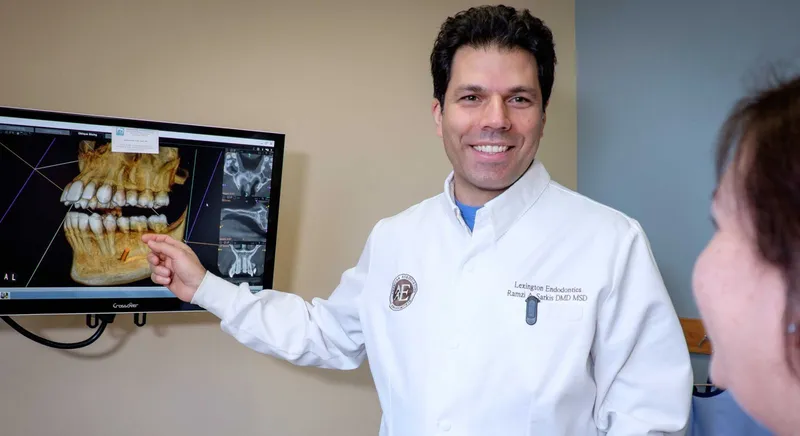
Cone Beam Computed Tomography (CBCT) has transformed dental diagnostics since its introduction in the early 2000s. Just as X-rays revolutionized medicine in the early 20th century by revealing internal body structures without surgery, CBCT offers a three-dimensional view of dental anatomy with remarkable clarity.
Unlike traditional X-rays or hospital CT scans, CBCT delivers detailed 3D images of complex areas like root canals, nerves, and jaw sinuses. This precision allows dentists to plan treatments more accurately, often reducing invasive procedures and speeding recovery.
While CBCT is a powerful diagnostic tool across many dental specialties, it does involve radiation exposure. At Lexington Endodontics, we carefully weigh the benefits against any risks to ensure your safety.
Request an AppointmentHow Cone Beam CT Works
X-rays are a form of electromagnetic energy that, unlike visible light, can penetrate bone and soft tissues. Conventional X-rays provide a flat, two-dimensional image from a single angle.
Imagine a flip book containing a sequence of images taken at slightly different angles. When flipped quickly, it creates the illusion of movement or a 3D view. Similarly, CBCT scanners capture between 150 and 600 X-ray images as the device rotates around your head in less than a minute.
Advanced computer software then compiles these slices into a detailed 3D model that can be viewed and manipulated on-screen from any angle—allowing your dentist to explore your anatomy thoroughly without discomfort or inconvenience.
Where Cone Beam CT Is Used
The 3D visualization from CBCT has become essential in several dental fields:
- Orthodontics: Precise imaging guides the movement of teeth and jaws for effective alignment.
- Dental Implants: Helps identify the best implant sites, avoiding sensitive nerves and sinuses.
- Orthognathic Surgery and TMJ Disorders: Provides surgeons with a comprehensive view for planning corrective jaw procedures and TMJ treatment.
- Oral Surgery: Assists in treating impacted teeth or tumors with detailed anatomical insight.
- Endodontics: Enables skilled visualization of complex root canal systems for better treatment outcomes.